Depopulation
Rural SW Manitoba 1965-1980

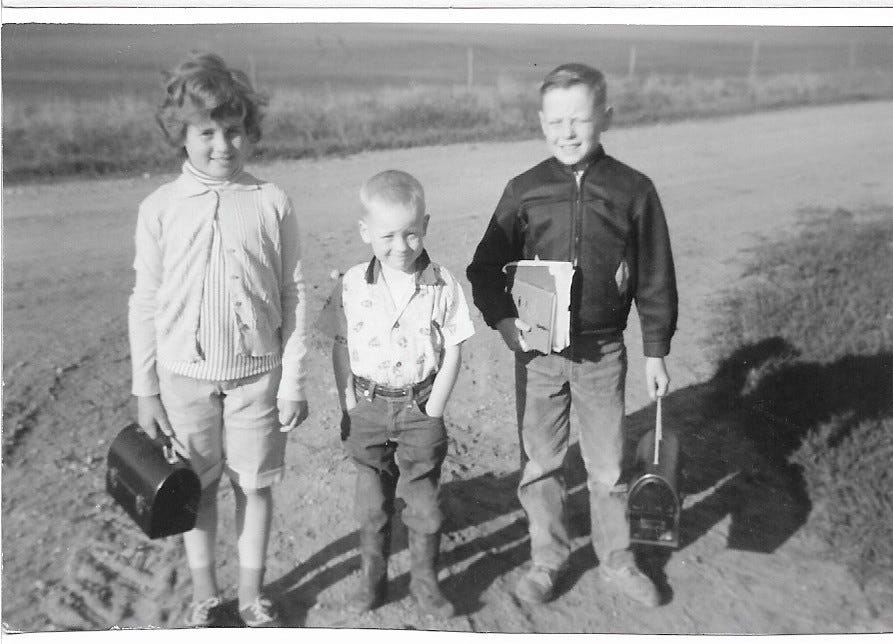
I narrowly missed attending a one-room schoolhouse. In 1965, the Manitoba provincial government initiated a school consolidation program, leading to the closure of thousands of rural schools. These buildings met various fates: some were boarded up, converted into homes or granaries, demolished, repurposed as community halls, buried, or even burned down. Teachers and students from these schools were consolidated into larger schools in towns, with newly purchased buses transporting rural children.
Some districts resisted the government's decision, retaining their school boards and schools. One district north of us built a modern school, vowing to remain independent. My father believed this was a mistake, anticipating the significant changes that would soon impact rural life. The local district struggled to maintain the school on their own, but demographics took over and within 10 years the school building was sold, and it was moved to a fate unknown to me.
In retrospect, I sometimes envy my siblings who walked or biked the mile and three-quarters to their rural school. While I might not have enjoyed the trek in rain or during a bitter October wind, I imagine myself skipping stones on sloughs, listening to red-winged blackbirds, or spotting coyotes chasing rabbits during the journey. My sister would likely have urged me to hurry, while my brother would have strolled ahead at his own pace.
However, in September 1966, I boarded a crowded school bus, joining other children aged 5 to 18. We arrived in town, where fifteen more buses discharged students from surrounding areas. The schools were overflowing, necessitating the use of portable classrooms ("huts") while a new school addition was built. It was an exciting time for the province, with the Canadian Centennial approaching and infrastructure struggling to keep pace with the influx of baby boomers into schools and universities.
Despite the optimism, subtle signs of change were evident. My parents built a new house in 1967, a significant upgrade with running water and indoor plumbing. I later learned that my father previously carried all water from the well at the barn for household use. Some neighbors still relied on hand pumps in their kitchens, which seemed luxurious to me at the time.
Alongside the new house, my parents purchased a new tractor, combine, swather, and seed drill – major investments that significantly improved farming efficiency. Within a few years, my brother purchased his first parcel of land. Times were prosperous: land, equipment, and inputs were relatively inexpensive, farmers received good prices for their crops, and global demand for Canadian grain was high.
While our family anticipated a positive future, many of our neighbors held serious discussions about the future of their farms. Would their sons inherit the farms? Was there sufficient capital for expansion and the purchase of newer, larger equipment? The allure of retiring in town was strong, and many young people sought opportunities in Winnipeg for careers, higher education, or simply to escape rural life. Some farmers were eager to expand their operations and made offers to acquire neighboring farms. As a child, I was largely oblivious to these underlying currents, but by the time I graduated high school, the rural landscape had undergone a dramatic transformation.
The farm my brother purchased had once supported a family of six or seven children. However, all of them eventually left the area, a pattern repeated across the region as smaller farms were absorbed into larger operations. The school bus that once carried forty children gradually carried fewer and fewer, eventually shrinking in size. Our high school football team, once a formidable 12-man squad competing against eight other rural schools, dwindled to a nine-man team facing only five opponents, today there is no football at my old school. The decline extended beyond the school system. Many small villages vanished. Our minor hockey league, which once encompassed nine towns within a 30-mile radius, was reduced to six, requiring longer travel distances. Sunday ball tournaments all but disappeared as there were less and less young people to field teams.
The consolidation of grain elevators and companies, the abandonment of rail lines by CN and CPKC, the disappearance of Greyhound bus service, the loss of local doctors and nurses, the rise of larger farms, and the closure of auto and farm equipment dealerships all contributed to the depopulation of rural Manitoba. While these changes may be viewed as progress, they have undeniably resulted in significant losses, leaving the nation poorer for the changes.
Please support this Substack by subscribing and sharing. As I get more comfortable with writing I’ll be doing more varied posts.
Cheers!